Modern businesses rely on efficient and cost-effective communication systems. SIP trunking, a revolutionary approach to phone systems, offers a compelling alternative to traditional landlines, promising significant improvements in scalability, functionality, and cost savings. This exploration delves into the multifaceted advantages of SIP trunking, examining its impact on operational efficiency and overall business performance.
By transitioning to SIP trunking, companies can streamline their communication infrastructure, reducing reliance on outdated and expensive technologies. This shift empowers businesses to adapt quickly to changing needs, optimize their communication strategies, and ultimately enhance their bottom line. We will explore the key benefits, addressing cost reductions, enhanced features, improved reliability, and global connectivity options.
Cost Savings of SIP Trunking
SIP trunking offers significant cost advantages over traditional phone systems, making it an attractive option for businesses of all sizes. The savings stem from reduced monthly fees, elimination of upfront capital expenditures, and increased operational efficiency. These benefits can lead to substantial long-term cost reductions, improving a company’s bottom line.
Switching to SIP trunking often results in a dramatic decrease in monthly telecom expenses compared to traditional phone lines. This reduction is primarily due to the lower per-line costs associated with SIP and the elimination of various line rental fees commonly associated with traditional Private Branch Exchange (PBX) systems. The cost savings can be even more pronounced for businesses with high call volumes or numerous locations.
Comparison of Monthly Costs: Traditional vs. SIP Trunking
The following table illustrates a comparative cost analysis for a hypothetical business with 10 phone lines. Note that actual savings will vary depending on the specific provider, location, and call volume.
| Provider | Monthly Fee (Traditional) | Monthly Fee (SIP) | Savings |
|---|---|---|---|
| Acme Telecom | $500 | $250 | $250 |
| Beta Communications | $600 | $300 | $300 |
| Gamma Networks | $450 | $200 | $250 |
Elimination of Upfront Hardware Costs
Traditional PBX systems require a significant upfront investment in hardware, including the PBX unit itself, cabling, and potentially additional equipment for features like voicemail or call conferencing. This initial capital expenditure can be substantial, especially for larger businesses. SIP trunking, however, eliminates this need. Since the call processing is handled by the provider’s infrastructure, businesses only need internet connectivity and compatible IP phones or softphones, significantly reducing upfront costs.
Real-World Examples of Cost Savings
Many businesses have successfully leveraged SIP trunking to significantly reduce their telecom costs. For instance, a small law firm with five employees reduced their monthly phone bill by 40% after switching to a SIP trunking solution. Similarly, a mid-sized retail chain with multiple locations reported annual savings exceeding $10,000 after implementing a company-wide SIP trunking system. These examples highlight the potential for substantial cost savings through the adoption of SIP trunking.
Scalability and Flexibility of SIP Trunking
SIP trunking offers unparalleled scalability and flexibility, making it an ideal solution for businesses of all sizes. Unlike traditional phone systems with fixed numbers of lines, SIP trunking allows for dynamic adjustments to meet evolving communication needs. This adaptability translates to cost savings, improved efficiency, and enhanced business agility. The ease of scaling up or down, combined with its seamless integration capabilities, positions SIP trunking as a future-proof communication solution.SIP trunking simplifies the process of adding or removing phone lines, enabling businesses to quickly adapt to changing demands.
Whether experiencing rapid growth requiring additional lines or downsizing and needing fewer, the process is straightforward and often managed through a simple online portal. This eliminates the delays and complexities associated with traditional phone line installations and removals.
Adding a New User to a SIP Trunking System
Adding a new user to a SIP trunking system is a streamlined process. The following steps Artikel a typical procedure, although specific steps may vary slightly depending on the provider and system configuration.
- Provisioning the User Account: The administrator accesses the SIP trunking provider’s online portal or management interface and creates a new user account. This typically involves specifying the user’s name, extension number, and other relevant details.
- Assigning a DID (Direct Inward Dialing) Number (Optional): If a dedicated phone number is required for the new user, a DID number is assigned to the account from the pool of available numbers provided by the SIP trunking provider.
- Configuring User Settings: The administrator configures various settings for the new user account, such as call routing, voicemail options, and access to specific features.
- Connecting the Device: The new user connects their phone (IP phone or softphone) to the network and configures it with the credentials provided during account creation. This involves entering the server address, username, password, and other necessary information.
- Testing the Connection: Once connected, the administrator or user performs a test call to ensure proper functionality and confirm that the new user can make and receive calls.
Integration with Various Communication Platforms and Applications
SIP trunking’s flexibility extends to its seamless integration with a wide range of communication platforms and applications. This interoperability enhances productivity and streamlines communication workflows. Businesses can integrate their SIP trunking system with CRM software, unified communications platforms, and other business applications, creating a unified communication environment. For example, call logs can be automatically logged within a CRM system, improving customer relationship management.
Similarly, integrating with a unified communications platform allows for seamless transitions between voice calls, video conferencing, and instant messaging.
Scaling a Phone System with SIP Trunking: A Scenario
Imagine a rapidly growing startup, “InnovateTech,” initially operating with a small team of 10 employees. They begin with a SIP trunking system supporting 10 lines. As InnovateTech expands its operations and hires an additional 20 employees within a year, they simply log into their SIP trunking provider’s portal and increase the number of lines to 30. This process is quick, cost-effective, and doesn’t involve the lengthy installation procedures associated with traditional phone systems.
Conversely, if InnovateTech later experiences a period of restructuring and reduces its workforce, they can just as easily decrease the number of lines to match their current needs, avoiding unnecessary expenses for unused lines. This dynamic scaling capability allows InnovateTech to efficiently manage its communication infrastructure in response to its changing business requirements.
Enhanced Features and Functionality of SIP Trunking
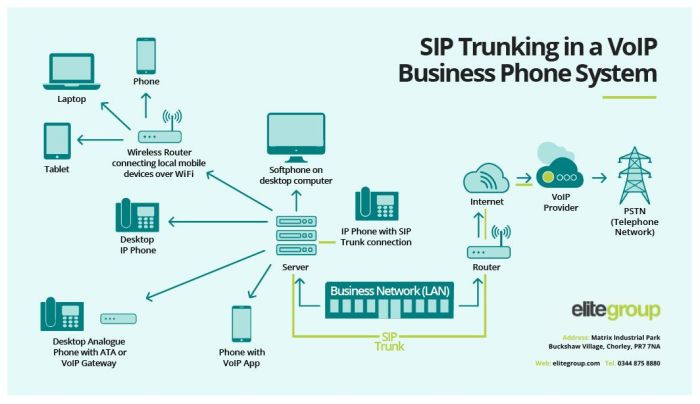
SIP trunking offers a significant leap forward in communication capabilities compared to traditional phone systems. Beyond the cost savings and scalability discussed previously, the advanced features integrated into SIP trunking solutions dramatically improve efficiency and enhance the overall communication experience for businesses of all sizes. These features are often customizable and tailored to specific business needs, offering a level of flexibility unavailable with traditional PBX systems.SIP trunking empowers businesses with a range of sophisticated features that streamline workflows and improve communication clarity.
This section details some key advantages, highlighting how they contribute to a more efficient and productive work environment.
Advanced Features Comparison: SIP Trunking vs. Traditional Phone Systems
The following table compares key features offered by SIP trunking and traditional phone systems. Note that the availability and specific implementation of features can vary depending on the chosen provider and system configuration.
| Feature | Description | Benefits | Implementation |
|---|---|---|---|
| Call Forwarding | Redirects incoming calls to a different number, such as a mobile phone, another extension, or a voicemail system. This can include options like unconditional forwarding (always forwarding), busy forwarding, and no answer forwarding. | Improved call accessibility, even outside the office. Ensures no calls are missed, leading to increased customer satisfaction and improved response times. Allows for flexible work arrangements. | Configured through the SIP trunking provider’s portal or management interface. Specific rules and conditions can be set for forwarding based on various criteria. |
| Voicemail-to-Email | Transcribes voicemail messages into text and sends them directly to the recipient’s email inbox. | Increased efficiency by allowing users to access messages regardless of location or device. Saves time by eliminating the need to listen to lengthy voicemails. Improves accessibility for employees who are frequently on the go. | Enabled through the SIP trunking provider’s platform; often requires email integration configuration. |
| Conferencing | Allows multiple participants to join a single call simultaneously, facilitating meetings, training sessions, and collaborative discussions. This can include features like audio conferencing, video conferencing, and screen sharing. | Facilitates seamless collaboration, reduces the need for travel, and saves time and resources. Improves communication efficiency and decision-making processes within teams. | Typically integrated into the SIP trunking platform; may require the use of a dedicated conferencing application or add-on. Can be easily scaled to accommodate a varying number of participants. |
| Find Me/Follow Me | Routes calls sequentially to multiple numbers (e.g., office phone, mobile phone, home phone) until the call is answered. | Ensures calls are always answered, regardless of the user’s location. Improves customer service by ensuring timely responses and minimizing missed calls. Offers high call availability. | Set up through the SIP trunking provider’s interface; allows customization of the order and number of destinations. |
Impact on Business Communication and Efficiency
The advanced features offered by SIP trunking significantly enhance business communication and efficiency. For instance, call forwarding ensures calls are answered promptly, even if employees are working remotely or are unavailable at their desks. Voicemail-to-email allows for quick access to messages, eliminating the delays associated with traditional voicemail retrieval. Conferencing capabilities streamline team collaboration, reducing the need for costly and time-consuming in-person meetings.
The cumulative effect of these features is a more agile, responsive, and efficient communication system that directly contributes to improved productivity and customer satisfaction. Businesses can leverage these capabilities to optimize their workflows, reduce operational costs, and enhance their overall competitive advantage.
Improved Reliability and Redundancy of SIP Trunking
SIP trunking offers significantly improved reliability and redundancy compared to traditional phone systems, resulting in enhanced business continuity and reduced downtime. Unlike traditional systems reliant on physical phone lines, SIP trunking leverages the internet’s inherent redundancy and diverse pathways for communication. This allows for multiple points of failure to be mitigated, ensuring consistent service even in the face of unexpected disruptions.SIP trunking achieves this higher reliability through various redundancy mechanisms.
These mechanisms ensure that calls are not dropped and communication remains uninterrupted, even if one part of the system fails. This contrasts sharply with traditional phone systems where a single cable cut or equipment malfunction can lead to widespread communication outages.
Failover and Disaster Recovery Mechanisms
Failover mechanisms are central to the enhanced reliability of SIP trunking. In a traditional system, a single point of failure, such as a PBX malfunction, would disrupt all calls. With SIP trunking, however, multiple paths and providers can be configured. If the primary provider experiences an outage, calls automatically switch to a secondary provider, ensuring minimal disruption. This seamless transition is achieved through sophisticated routing protocols that constantly monitor the network’s health and reroute traffic as needed.
Disaster recovery plans are similarly enhanced. Businesses can leverage geographically diverse providers, ensuring continued operation even in the event of widespread regional outages, such as those caused by natural disasters. For instance, a company with offices in multiple cities might utilize SIP trunk providers in different regions, thus mitigating the risk of a single disaster impacting all communication.
Impact of Improved Reliability on Business Continuity
The improved reliability of SIP trunking directly translates to enhanced business continuity. Reduced downtime means increased productivity and fewer lost opportunities. Customer service remains uninterrupted, maintaining positive customer relationships. Employees can continue working efficiently, even during unexpected disruptions. The financial implications of reduced downtime are significant, minimizing losses associated with operational disruptions and preventing reputational damage from service interruptions.
The ability to maintain communication during crises is invaluable, allowing businesses to coordinate emergency response and keep stakeholders informed.
Case Study: Weather-Related Outage and SIP Trunking Resilience
A mid-sized insurance company, “Acme Insurance,” experienced a major snowstorm that caused widespread power outages and significant disruption to traditional phone services in their region. Their competitors, using traditional phone lines, experienced complete communication failure for several days, resulting in significant customer service disruptions and reputational damage. However, Acme Insurance, utilizing a SIP trunking system with redundant providers, experienced minimal disruption.
While some employees worked remotely due to power outages, the company’s main call center remained operational thanks to the automatic failover to a secondary provider located in a different region. The company was able to maintain communication with clients, process claims, and continue operations with minimal interruption, demonstrating the significant advantage of SIP trunking in maintaining business continuity during a crisis.
This event solidified their decision to invest in SIP trunking, proving its value in mitigating risks and safeguarding their business operations.
Electronic Telephone Systems
SIP trunking offers significant advantages when integrated with various electronic telephone systems, improving efficiency and reducing costs. The compatibility and integration process depend on the specific system’s architecture and capabilities. Understanding these factors is crucial for a smooth transition.SIP trunking is compatible with a wide range of electronic telephone systems, from legacy PBX systems to modern IP-PBX and cloud-based solutions.
The integration process itself varies depending on the existing infrastructure and desired functionalities.
Types of Electronic Telephone Systems Compatible with SIP Trunking
Many types of electronic telephone systems readily integrate with SIP trunking. These include traditional Private Branch Exchange (PBX) systems, often requiring the addition of a SIP gateway or media gateway; IP-PBX systems, which are designed for VoIP and often natively support SIP; and cloud-based phone systems, which typically utilize SIP as their core communication protocol. Hybrid systems, combining aspects of traditional and IP-based technologies, also benefit from SIP trunking integration.
Integrating SIP Trunking with Existing Electronic Telephone Systems
The integration of SIP trunking with an existing electronic telephone system involves several key steps. A well-planned approach ensures a seamless transition and minimizes disruption.
Challenges and Considerations for Integrating SIP Trunking with Legacy Systems
Integrating SIP trunking with legacy systems presents unique challenges. Older PBX systems may lack native SIP support, requiring the deployment of a media gateway or session border controller (SBC) to translate between the legacy system’s proprietary protocols and the SIP protocol. This adds complexity and cost. Furthermore, compatibility issues may arise due to differences in signaling protocols and codecs.
Careful planning and testing are essential to ensure successful integration and avoid potential service disruptions. Thorough assessment of the legacy system’s capabilities and limitations is crucial before initiating the integration process. This includes verifying the system’s capacity to handle the increased call volume and features offered by SIP trunking. Security considerations, such as firewalls and network security protocols, also need to be addressed to protect the system from unauthorized access.
Security Considerations with SIP Trunking
SIP trunking, while offering significant advantages for modern phone systems, introduces new security challenges that must be addressed proactively. Failing to implement robust security measures can expose your organization to significant risks, including data breaches, service disruptions, and financial losses. Understanding these risks and implementing appropriate mitigation strategies is crucial for ensuring the secure and reliable operation of your SIP trunking infrastructure.
Security threats targeting SIP trunking are multifaceted, ranging from unauthorized access and eavesdropping to denial-of-service attacks and malicious call manipulation. A layered security approach, incorporating both technical and procedural safeguards, is necessary to effectively mitigate these risks. This approach involves careful selection of equipment and providers, robust authentication and encryption protocols, regular security audits, and employee training.
Potential Security Risks and Mitigation Strategies
The following table Artikels several potential security risks associated with SIP trunking, along with corresponding mitigation strategies, implementation details, and the impact of neglecting these measures.
| Risk | Mitigation Strategy | Implementation | Impact |
|---|---|---|---|
| Unauthorized Access | Strong passwords, multi-factor authentication (MFA), access control lists (ACLs) | Enforce strong password policies, implement MFA using time-based one-time passwords (TOTP) or similar methods, configure ACLs to restrict access to authorized users and IP addresses. | Data breaches, unauthorized calls, system compromise. |
| Eavesdropping and Call Interception | TLS/SRTP encryption, secure signaling protocols | Enable TLS encryption for signaling and SRTP encryption for media streams. Regularly update and patch your SIP infrastructure. | Data breaches, privacy violations, loss of confidential information. |
| Denial-of-Service (DoS) Attacks | Intrusion detection/prevention systems (IDS/IPS), rate limiting, traffic filtering | Deploy IDS/IPS to monitor network traffic for suspicious activity. Implement rate limiting to prevent flooding attacks. Configure firewalls to filter unwanted traffic. | Service disruption, loss of business continuity. |
| SIP Hijacking | Secure authentication mechanisms, session border controllers (SBCs) | Implement strong authentication mechanisms such as TLS mutual authentication. Use an SBC to filter and control SIP traffic. | Unauthorized access to accounts, fraudulent calls, billing fraud. |
| Man-in-the-Middle (MitM) Attacks | TLS/SRTP encryption, certificate pinning | Use TLS/SRTP encryption to protect signaling and media streams. Implement certificate pinning to prevent MitM attacks. | Eavesdropping, data manipulation, unauthorized access. |
Importance of Secure Protocols and Encryption
Secure protocols and encryption are fundamental to securing SIP trunking. Transport Layer Security (TLS) protects signaling traffic, ensuring that communication between SIP endpoints remains confidential and integrity is maintained. Secure Real-time Transport Protocol (SRTP) provides encryption for media streams, preventing eavesdropping on voice and video calls. The use of these protocols is paramount in preventing data breaches and ensuring the confidentiality of sensitive communications.
Best Practices for Securing a SIP Trunking System
Implementing a comprehensive security strategy requires a multi-layered approach. The following best practices should be incorporated to strengthen the overall security posture of your SIP trunking system.
- Regularly update and patch your SIP infrastructure to address known vulnerabilities.
- Implement strong password policies and multi-factor authentication to restrict access.
- Use a Session Border Controller (SBC) to filter and control SIP traffic.
- Enable TLS and SRTP encryption to protect signaling and media streams.
- Monitor network traffic for suspicious activity using intrusion detection/prevention systems.
- Conduct regular security audits and penetration testing to identify and address vulnerabilities.
- Train employees on security best practices to minimize human error.
- Employ robust access control lists (ACLs) to restrict access to authorized users and IP addresses.
- Regularly review and update your security policies and procedures.
Geographic Reach and Global Connectivity
SIP trunking significantly expands a business’s communication capabilities beyond geographical limitations, enabling seamless interaction with clients, partners, and employees worldwide. This is achieved by leveraging the internet’s infrastructure, eliminating the need for costly and complex international phone lines. This allows businesses to operate more efficiently and cost-effectively on a global scale.SIP trunking facilitates communication across geographical boundaries by routing calls over the internet protocol (IP).
Instead of relying on traditional PSTN (Public Switched Telephone Network) lines, which often involve expensive international call charges and complex routing, SIP trunking utilizes a single, unified communication system accessible anywhere with an internet connection. This allows businesses to make and receive calls to and from virtually any location, regardless of the distance. For example, a multinational corporation with offices in London, New York, and Hong Kong can easily connect all its locations using a single SIP trunking system, enabling seamless internal communication and reducing international call costs.
Another example is a small business that provides customer support services globally; they can utilize a SIP trunking solution to handle calls from various countries at a fraction of the cost of traditional methods.
International Expansion Facilitated by SIP Trunking
Businesses are increasingly leveraging SIP trunking for international expansion. This technology enables them to establish a global presence without the significant upfront investment and ongoing costs associated with setting up separate phone systems in each country. The scalability of SIP trunking also allows businesses to easily add or remove users and locations as needed, adapting to changes in their operational requirements.
A retail company opening new stores in several countries, for instance, can rapidly provision phone numbers and connect those locations to their central system using SIP trunking, allowing immediate communication between the new stores and headquarters. This contrasts sharply with the significant time and expense required to establish traditional phone lines in multiple countries.
Benefits of Global Connectivity for Businesses with Distributed Workforces
For businesses with multiple offices or remote workers, global connectivity offered by SIP trunking is invaluable. It enables seamless communication and collaboration between teams regardless of their physical location. This improves productivity, reduces communication delays, and fosters a more unified and cohesive work environment. A software development company with teams in different time zones, for example, can use SIP trunking to facilitate real-time communication and collaboration throughout the project lifecycle, irrespective of geographical distance.
Instant messaging, video conferencing, and other unified communications features further enhance this collaboration, fostering efficient teamwork and reducing project completion times.
Cost-Effectiveness of SIP Trunking for International Calls
SIP trunking offers significant cost savings compared to traditional methods for international calls. Traditional international calls often involve high per-minute charges and complex billing structures. SIP trunking, however, typically charges a flat monthly fee for a set number of channels, with lower per-minute rates for international calls. This predictable pricing structure simplifies budgeting and reduces overall communication costs. A company with frequent international calls can experience substantial savings by switching from traditional phone lines to SIP trunking.
The savings can be particularly significant for businesses with high call volumes or numerous international locations. The difference in costs can be dramatic, with SIP trunking often reducing international call expenses by 50% or more, depending on usage and specific pricing plans.
In conclusion, the benefits of implementing SIP trunking for modern phone systems are undeniable. From substantial cost reductions and increased scalability to enhanced features and improved reliability, SIP trunking provides a comprehensive solution for businesses of all sizes. By embracing this technology, organizations can optimize their communication infrastructure, improve operational efficiency, and gain a competitive edge in today’s dynamic marketplace.
The transition to a SIP-based system represents a strategic investment that yields significant long-term returns in terms of both cost savings and enhanced communication capabilities.
Clarifying Questions
What are the security risks associated with SIP trunking, and how can they be mitigated?
SIP trunking, like any IP-based system, is susceptible to security vulnerabilities such as unauthorized access, eavesdropping, and denial-of-service attacks. Mitigation strategies include employing strong passwords, using secure protocols (SRTP, TLS), implementing firewalls, and regularly updating software. Robust security measures are crucial to protect sensitive business communications.
Can SIP trunking integrate with my existing PBX system?
The feasibility of integrating SIP trunking with your existing PBX system depends on the system’s capabilities. Many modern PBX systems offer native SIP support, allowing for seamless integration. Older systems may require upgrades or the use of a gateway to enable compatibility. A thorough assessment of your existing system is recommended before implementation.
How does SIP trunking handle emergency calls (911)?
Emergency call handling with SIP trunking requires careful consideration. It’s essential to ensure your provider complies with all relevant regulations and offers accurate location services for emergency calls. This may involve additional configuration or specialized services.