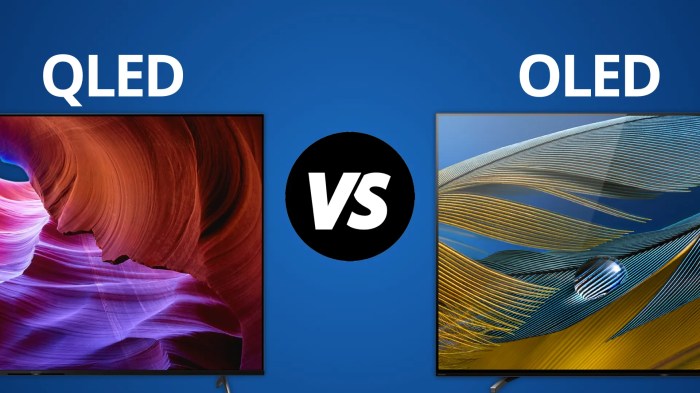
The world of television technology is constantly evolving, with OLED and QLED displays leading the charge. Both offer stunning visuals, but understanding their fundamental differences is crucial for making an informed purchase. This exploration delves into the core technologies, comparing image quality, brightness, lifespan, cost, and ideal applications to help you navigate the complexities of these advanced display systems.
From the underlying principles of light emission to the practical considerations of cost and longevity, we will dissect the key features of OLED and QLED screens. We’ll examine how each technology achieves its unique visual characteristics, considering factors such as contrast ratios, color accuracy, and viewing angles. The aim is to equip you with the knowledge necessary to choose the display technology that best suits your needs and budget.
Introduction to OLED and QLED Technologies
OLED and QLED are two leading display technologies vying for dominance in the consumer electronics market. While both offer vibrant images and improved contrast compared to older LCD technology, they achieve this through fundamentally different approaches. Understanding these differences requires examining their core principles, manufacturing processes, and historical development.OLED and QLED displays differ significantly in their light-emitting mechanisms. OLED, or Organic Light-Emitting Diode, technology uses organic compounds that emit light when an electric current is passed through them.
Each pixel in an OLED display is self-emissive, meaning it generates its own light without the need for a backlight. QLED, or Quantum Dot Light-Emitting Diode, on the other hand, utilizes quantum dots – semiconductor nanocrystals – to enhance the color and brightness of a traditional LED backlight. While QLED pixels themselves don’t emit light directly, the quantum dots convert the backlight’s blue light into a wider spectrum of colors, resulting in a more vibrant and accurate image.
OLED Manufacturing Process
The manufacturing of OLED displays is a complex process involving several steps. First, a substrate, typically glass, is prepared. Then, multiple layers of organic materials are deposited onto the substrate through techniques like vapor deposition or inkjet printing. These layers include the anode, the organic light-emitting layer, and the cathode. Finally, a protective layer is added to seal the organic layers and protect them from environmental damage.
The precision required for the deposition of these thin organic layers is crucial to the performance and longevity of the display. Variations in this process, such as the specific organic materials used and the deposition techniques employed, lead to differences in the quality and characteristics of the final OLED display.
QLED Manufacturing Process
QLED display manufacturing involves integrating quantum dots into an existing LED backlight system. The quantum dots, typically cadmium-based or indium-phosphide-based nanocrystals, are synthesized and then incorporated into a film or layer within the backlight unit. This film then filters the blue light emitted by the LEDs, converting it into red and green light, thereby creating a wider color gamut.
The precise size and composition of the quantum dots determine the color they emit. The manufacturing process necessitates careful control over the size distribution of the quantum dots to ensure consistent color reproduction across the display. This technology relies heavily on the advancements made in semiconductor nanocrystal synthesis and integration.
Historical Development of OLED Technology
The initial research into organic light-emitting diodes began in the early 1950s, with the first working OLED device demonstrated in the 1980s. Early OLED displays suffered from short lifespans and limited efficiency, hindering their widespread adoption. However, significant advancements in materials science and manufacturing techniques throughout the late 1990s and 2000s led to improvements in efficiency, lifespan, and color reproduction, paving the way for their use in small displays like mobile phones and eventually larger televisions.
The continuous development of new organic materials and refined fabrication processes continues to drive the improvement of OLED technology.
Historical Development of QLED Technology
While the underlying principles of quantum dots were discovered decades earlier, the development of QLED technology as a viable display technology accelerated in the 2010s. Companies like Samsung invested heavily in research and development, leading to the commercialization of QLED televisions. The initial challenges included the stability and cost-effectiveness of quantum dot synthesis and integration into display panels.
Ongoing research focuses on improving the quantum dot’s brightness, color purity, and long-term stability, while also exploring alternative materials to reduce manufacturing costs and environmental impact. The ongoing refinement of quantum dot synthesis and integration techniques continues to improve the performance and affordability of QLED displays.
Image Quality Comparison

OLED and QLED technologies, while both offering high-quality displays, present distinct differences in image quality. These differences stem from their fundamental technological variations, impacting color accuracy, contrast, and viewing angles. Understanding these distinctions helps consumers make informed decisions based on their specific needs and preferences.
Color Accuracy and Gamut
OLED’s self-emissive pixels allow for exceptionally accurate color reproduction. Each pixel generates its own light, enabling precise control over color intensity and resulting in a wider color gamut. QLED, while also capable of vibrant colors, relies on a backlight, potentially leading to slight color inconsistencies across the screen. While advancements in QLED technology have significantly narrowed the gap, OLED generally maintains a slight edge in color accuracy, particularly in the representation of darker shades.
The wider color gamut in OLED translates to a more lifelike and nuanced depiction of colors, especially beneficial for viewing HDR content.
Contrast Ratios and Black Levels
The most significant difference lies in contrast ratios. OLED’s self-emissive nature allows for perfect blacks; pixels can be completely turned off, resulting in an infinite contrast ratio theoretically. This creates incredibly deep blacks and exceptional detail in dark scenes. QLED, using a backlight, struggles to achieve true blacks, resulting in a significantly lower contrast ratio, though advancements have led to improved black levels in recent years.
The difference is particularly noticeable in scenes with both bright and dark elements; OLED displays exhibit superior depth and clarity. This contrast difference greatly impacts the overall perceived image quality, especially for movies and games with dark scenes.
Viewing Angles
Viewing angles also differ between the two technologies. OLED displays generally offer wider viewing angles with minimal color shift or contrast reduction when viewed from an angle. QLED displays, particularly those using edge-lit backlights, can experience more noticeable color shifting and contrast loss when viewed off-axis. This means the image quality can degrade significantly depending on the viewing position with QLED, while OLED maintains consistent quality across a broader range of viewing angles.
This is particularly relevant for shared viewing experiences or larger screens where multiple viewers are positioned at different angles.
Image Quality Comparison Table
| Aspect | OLED | QLED |
|---|---|---|
| Contrast Ratio | Essentially infinite | High, but significantly lower than OLED |
| Black Levels | Perfect blacks (pixels completely off) | Dark grays, not true black |
| Color Accuracy | Excellent, very precise color reproduction | Good, but can have slight inconsistencies |
| Color Gamut | Wide, often exceeding DCI-P3 | Wide, but generally slightly smaller than OLED |
| Viewing Angles | Excellent, minimal color shift | Good, but can experience color shift and contrast loss at extreme angles |
Brightness and Power Consumption
OLED and QLED technologies differ significantly in how they achieve brightness and manage power consumption, leading to varying user experiences. Understanding these differences is crucial for choosing the right display technology based on individual needs and priorities. This section will explore the peak brightness capabilities of each technology and analyze their respective power consumption characteristics.OLED and QLED displays employ fundamentally different methods for producing light, resulting in distinct brightness and power consumption profiles.
QLED technology utilizes a backlight to illuminate the liquid crystals, allowing for exceptionally high peak brightness levels. Conversely, OLED technology achieves its luminance through self-emissive pixels, meaning each pixel generates its own light. This inherent characteristic leads to superior contrast ratios but generally lower peak brightness compared to QLED.
Peak Brightness Capabilities
QLED displays consistently achieve higher peak brightness levels than OLED displays. This is due to the backlight system employed in QLED, which can deliver significantly more light output than the self-emissive pixels of OLED panels. High peak brightness is particularly advantageous for viewing content in brightly lit rooms, ensuring image clarity and vibrancy even under challenging ambient light conditions.
While OLED technology has seen improvements in peak brightness over recent years, QLED generally maintains a considerable advantage in this area, with some high-end QLED models exceeding 2000 nits. In contrast, many OLED displays top out around 1000 nits, though this is continually evolving.
Power Consumption Differences
OLED displays generally consume less power than QLED displays, particularly when displaying dark scenes or images with a high proportion of black pixels. Because OLED pixels are self-emissive, they only consume power when illuminated. In contrast, QLED displays constantly power the backlight, regardless of the content being displayed. This difference translates to noticeable power savings with OLED technology, especially during extended viewing sessions or when watching content with predominantly dark scenes.
However, this advantage can diminish when displaying bright scenes, as OLED pixels require more energy to achieve high luminance levels.
Impact on User Experience
The differences in brightness and power consumption directly impact the user experience. High peak brightness in QLED displays enhances viewing in bright environments, making them suitable for gaming or watching movies in sunlit rooms. However, the higher power consumption may lead to increased energy bills and potentially higher heat generation. Conversely, the lower power consumption of OLED displays translates to energy savings and reduced heat output.
The superior contrast ratio resulting from perfect blacks in OLED panels contributes to a more immersive and visually engaging experience, especially for content with deep shadows and subtle details. The lower peak brightness of OLED might be a limitation in bright environments, but the enhanced contrast and lower power consumption are significant advantages in other viewing conditions.
Lifespan and Burn-in
OLED and QLED display technologies, while both offering vibrant visuals, differ significantly in their lifespan and susceptibility to image retention issues, commonly known as burn-in. Understanding these differences is crucial for making an informed purchasing decision, especially considering the long-term investment involved. This section will explore the typical lifespan of each technology and delve into the potential for burn-in, along with methods to mitigate its occurrence.OLED displays, while offering superior contrast and black levels, are more prone to burn-in than their QLED counterparts.
Burn-in is a permanent discoloration or image retention on the screen, typically resulting from prolonged display of static elements like channel logos or HUDs in games. This is because OLED pixels are self-emissive; prolonged excitation of individual pixels can lead to their degradation faster than others. QLED displays, utilizing a backlight system, are less susceptible to this issue because the backlight illuminates the entire screen, preventing the uneven degradation associated with self-emissive pixels.
OLED Lifespan and Burn-in Mitigation
The lifespan of an OLED display is typically cited as around 100,000 hours before noticeable degradation, although this can vary significantly based on usage patterns and brightness levels. Burn-in is a more critical concern. However, modern OLED panels incorporate various mitigation techniques to minimize the risk. These include pixel shifting, which slightly adjusts the position of displayed content to avoid prolonged excitation of the same pixels, and automatic brightness adjustments that reduce peak brightness over extended periods.
Furthermore, many modern OLED TVs include burn-in protection features that detect static elements and automatically adjust the brightness or shift the image slightly to prevent permanent damage. For example, some manufacturers incorporate algorithms that detect and mitigate the impact of static elements like news tickers or game HUDs. These features, coupled with responsible usage habits, can significantly extend the lifespan and reduce the likelihood of burn-in.
QLED Lifespan and Factors Affecting Longevity
QLED displays generally boast a longer lifespan than OLEDs, often exceeding 100,000 hours under typical usage. While less susceptible to burn-in, QLED screens can still degrade over time. Several factors influence their longevity. High brightness levels, especially sustained peak brightness, can accelerate the degradation of the backlight and quantum dots. Similarly, prolonged exposure to direct sunlight or extreme temperatures can negatively impact the display’s performance and lifespan.
Regular calibration and avoiding extreme settings can help maintain the quality and extend the life of a QLED display. For instance, using a lower brightness setting during nighttime viewing can significantly reduce the strain on the backlight and contribute to a longer lifespan. Regular use of screen savers and power-saving modes also helps to mitigate the effects of prolonged usage at high brightness.
Factors Affecting OLED and QLED Lifespan
Both OLED and QLED technologies are affected by various factors that influence their lifespan. These include:* Brightness levels: Higher brightness settings accelerate degradation in both technologies.
Ambient temperature
Extreme temperatures can shorten the lifespan of both displays.
Usage patterns
Prolonged display of static images significantly impacts OLED lifespan.
Image content
High contrast images and bright colors can contribute to faster degradation.
Manufacturing variations
Individual panel variations can lead to differences in lifespan.The interplay of these factors highlights the importance of responsible usage to maximize the lifespan of any display technology. While OLEDs offer superior picture quality, the potential for burn-in necessitates careful consideration and utilization of built-in mitigation features. QLEDs, while less prone to burn-in, are still susceptible to degradation from high brightness and extreme environmental conditions.
Understanding these nuances is key to making an informed choice based on individual needs and usage habits.
Cost and Availability
The price and accessibility of OLED and QLED televisions and monitors vary significantly, influenced by factors like screen size, features, and brand reputation. Generally, OLED displays command a higher price point than comparable QLED models, although the price gap is narrowing in some market segments. Availability also differs, with QLED technology being more widely distributed across various price points and screen sizes.OLED and QLED display pricing reflects a complex interplay of manufacturing costs, technological complexities, and market demand.
The premium associated with OLED often stems from the more intricate manufacturing process, involving self-emissive pixels, which adds to the overall production cost. QLED, using a backlight system with quantum dots, generally has a simpler manufacturing process, resulting in lower production costs and consequently, more competitive pricing.
Pricing Across Screen Sizes
The cost difference between OLED and QLED displays becomes more pronounced as screen size increases. For smaller screens, such as those found in monitors (under 32 inches), the price difference may be less significant, with some high-end QLED monitors rivaling or even exceeding the cost of smaller OLED monitors. However, for larger screen sizes (55 inches and above), the price premium for OLED TVs is typically substantial.
A 65-inch OLED TV will consistently cost more than a comparable 65-inch QLED TV. This is primarily due to the increased material and manufacturing costs associated with larger OLED panels. For example, a hypothetical 55-inch QLED TV might retail around $800-$1200, while a similar-sized OLED TV could range from $1500 to $2500 or more, depending on the brand and specific features.
Market Availability
QLED technology currently enjoys broader market availability than OLED. A wider range of manufacturers produces QLED televisions and monitors, leading to a greater variety of models and price points available to consumers. OLED technology, while gaining traction, is still produced by a smaller number of manufacturers, limiting the overall number of available models, especially at the lower price points.
This restricted availability often contributes to higher prices for OLED displays, particularly at larger screen sizes. Finding a 77-inch or larger OLED TV is significantly easier than finding a comparably sized QLED model, although the cost difference will be more pronounced.
Factors Influencing Pricing
Several factors contribute to the price differences between OLED and QLED technologies. Manufacturing complexity, as mentioned, plays a key role. OLED’s self-emissive nature requires more precise manufacturing techniques and higher-quality materials, increasing production costs. The demand for OLED technology also influences pricing; its perceived superior image quality often translates to a higher price tag. Additionally, brand reputation and included features (such as HDR support, higher refresh rates, or advanced smart TV functionality) significantly impact the final retail price of both OLED and QLED displays, regardless of the underlying display technology.
Economies of scale also play a role; as production volumes increase for either technology, the cost per unit tends to decrease.
Use Cases and Applications
OLED and QLED technologies, while both offering high-quality displays, cater to different needs and preferences due to their inherent strengths and weaknesses. Understanding these differences is crucial for selecting the appropriate display technology for various applications. The following sections detail ideal use cases for each technology, highlighting their respective advantages.
OLED Applications
OLED’s superior contrast ratio, perfect blacks, and wide viewing angles make it particularly well-suited for applications demanding exceptional image quality and vibrant colors. Its thin profile also lends itself to sleek and modern designs.
- High-end Smartphones and Tablets: The vibrant colors and deep blacks enhance the viewing experience on smaller screens, making OLED a popular choice for premium mobile devices.
- Premium Televisions: OLED TVs deliver stunning picture quality, particularly beneficial for watching movies and shows in dark environments. The perfect blacks create incredible depth and realism.
- Professional Monitors (Color-critical work): The accurate color reproduction and wide color gamut are essential for graphic designers, photographers, and video editors who require precise color representation.
- Virtual Reality (VR) Headsets: OLED’s fast response times and high contrast are crucial for minimizing motion blur and providing a smooth, immersive VR experience.
QLED Applications
QLED’s strength lies in its high brightness and excellent HDR performance, making it ideal for applications requiring exceptional luminance and detail in brightly lit environments.
- Large-screen Televisions: QLED TVs excel in brightly lit living rooms, maintaining image clarity and vibrancy even under strong ambient light. Their higher brightness also enhances HDR content.
- Gaming Monitors: The high refresh rates and low input lag offered by many QLED gaming monitors are critical for competitive gaming, providing a smoother and more responsive experience.
- Commercial Displays (e.g., Digital Signage): QLED’s high brightness ensures visibility in high-ambient light environments like shopping malls or airports, making them suitable for digital signage applications.
Comparative Table: Ideal Use Cases for OLED and QLED
The following table summarizes the ideal applications for OLED and QLED displays based on their respective strengths.
| Application | OLED | QLED |
|---|---|---|
| Home Theater | Excellent; superior contrast and black levels enhance movie viewing | Good; high brightness handles ambient light well |
| Gaming | Good; fast response times minimize motion blur; some high refresh rate models available | Excellent; high brightness, high refresh rates, and low input lag are ideal for competitive gaming |
| Professional Use (e.g., Graphic Design) | Excellent; accurate color reproduction and wide color gamut are crucial for color-critical work | Good; suitable for general use, but may not be as precise as OLED for color-critical applications |
| Smartphones | Excellent; vibrant colors and deep blacks enhance the viewing experience on smaller screens | Good; generally less expensive option |
| Large-screen TVs (65″+) | Good; delivers excellent picture quality but can be more expensive | Excellent; high brightness ideal for brightly lit rooms; generally more affordable than OLED at larger sizes |
Electronic Telephone Systems
Electronic telephone systems have revolutionized communication, evolving from simple analog networks to sophisticated digital infrastructures. This evolution has dramatically increased capacity, improved call quality, and enabled a wide range of new services. Understanding the architecture and key components of these systems is crucial to appreciating their impact on modern society.
Public Switched Telephone Network (PSTN) Architecture
The Public Switched Telephone Network (PSTN) is a vast, globally interconnected system that facilitates voice communication. Its architecture can be visualized as a hierarchical structure. At the lowest level are individual subscriber lines connecting to local exchanges. These exchanges are interconnected through trunk lines to regional and then national exchanges. Finally, international gateways connect national networks to allow global communication.
The PSTN relies on a circuit-switched architecture, meaning a dedicated physical path is established between two communicating parties for the duration of the call. This contrasts with packet-switched networks, which break down data into packets and route them individually. The PSTN’s hierarchical structure ensures scalability and resilience, allowing it to handle a massive number of simultaneous calls.
Functionality of Key Components in Modern Electronic Telephone Systems
Modern electronic telephone systems utilize various components to efficiently manage and route calls. Switches act as central hubs, connecting calls between different lines. They employ sophisticated algorithms to determine the most efficient path for a call and manage call setup and termination. Routers, while less directly involved in call routing in the traditional PSTN compared to packet-switched networks like the internet, play an increasing role in managing data traffic related to modern telephony services, such as VoIP.
Codecs (coder-decoders) are essential for converting analog voice signals into digital format for transmission and vice-versa. This digital conversion allows for more efficient transmission and enables the integration of various digital services.
Evolution of Electronic Telephone Systems: Analog to Digital
The evolution of electronic telephone systems can be broadly categorized into several generations, each marked by significant technological advancements. Early systems relied on analog technology, using physical circuits to transmit voice signals. This approach was limited in capacity and prone to noise and signal degradation. The introduction of digital technology revolutionized the industry. Digital systems convert analog voice signals into digital data, allowing for more efficient transmission, improved call quality, and the integration of additional services like call waiting and caller ID.
Furthermore, digital switching allowed for greater flexibility and scalability compared to analog systems. The transition from analog to digital was gradual, with many systems employing hybrid analog-digital approaches before complete digitalization.
Generations of Electronic Telephone Systems
The following list Artikels the different generations of electronic telephone systems, highlighting their key characteristics:
- First Generation (Electromechanical): These systems relied on electromechanical switches, such as Strowger switches, to connect calls. They were slow, bulky, and had limited capacity.
- Second Generation (Electronic Switching Systems – ESS): The introduction of electronic switching systems marked a significant improvement. These systems used electronic components to manage calls, offering increased speed, capacity, and reliability. Examples include early ESS systems developed by companies like AT&T.
- Third Generation (Digital Switching Systems): This generation saw the widespread adoption of digital technology, leading to significant improvements in call quality, capacity, and the ability to integrate new services.
- Fourth Generation (IP-based Systems): This generation integrates voice over internet protocol (VoIP), allowing calls to be transmitted over data networks. This enables features such as unified communications, video conferencing, and other advanced services.
- Fifth Generation (Cloud-based and Software-Defined Networking): This represents the current state of the art, with systems leveraging cloud computing and software-defined networking to provide highly scalable, flexible, and cost-effective solutions. This allows for easier management and integration of various services.
Illustrative Example
Let’s consider a vibrant cityscape at night, a common scene used to showcase display capabilities. This example will highlight the differences in how OLED and QLED technologies render this image.Imagine the scene: towering skyscrapers pierce a deep twilight sky, their windows ablaze with warm interior light. Neon signs flash with saturated colors along bustling streets below, reflecting in the wet pavement.
Color Saturation and Contrast
In the OLED rendition, the blacks are incredibly deep and inky, a true absence of light. The neon signs pop with almost unrealistically saturated colors, their hues intense and vibrant against the absolute black background. The contrast between the bright lights and the dark night sky is dramatic and breathtaking; each detail, even subtle reflections, is crisply defined.
The warm glow from the windows of the skyscrapers appears rich and nuanced, showing a subtle gradation of tones. In comparison, the QLED version displays a similar scene, but the blacks appear more like a very dark gray, a subtle light still present. While the neon signs are still bright, their colors lack the same punch and vibrancy as the OLED version.
The contrast is less pronounced, and some details in the darker areas of the image might be slightly lost in the shadow. The warm light from the windows, while present, appears less rich and detailed, lacking the subtle gradations of the OLED display.
Black Levels and Detail in Shadow
The difference in black levels is particularly striking in the shadowed areas beneath the buildings. On the OLED screen, these areas are truly black, allowing the brighter elements of the scene to stand out even more prominently. Fine details, like the texture of the pavement or the reflections in puddles, are easily discernible. On the QLED screen, however, these shadowy areas retain a degree of gray, obscuring some details and reducing the overall impact of the scene’s contrast.
The subtle textures and reflections are less visible, making the image appear somewhat flatter.
Ultimately, the choice between OLED and QLED hinges on individual priorities. OLED excels in perfect blacks and superior contrast, making it ideal for dark-room viewing and cinematic experiences. QLED, on the other hand, boasts higher peak brightness and wider color gamut, better suited for brightly lit rooms and vibrant visuals. By carefully weighing the advantages and disadvantages of each technology, consumers can make a well-informed decision that aligns with their viewing preferences and budget constraints.
FAQ Guide
What is the best technology for gaming?
For fast-paced gaming, QLED’s higher refresh rates and lower input lag often provide a smoother experience. However, OLED’s superior response times can be beneficial in certain competitive scenarios.
Which technology is more energy efficient?
OLED generally consumes less power than QLED, especially when displaying dark scenes, due to its self-emissive nature. However, this difference can vary depending on brightness levels and content.
Do QLED screens suffer from burn-in?
No, QLED screens do not suffer from burn-in. Burn-in is a concern primarily associated with OLED technology.
Which is better for HDR content?
Both technologies support HDR, but QLED’s higher peak brightness often results in a more impactful HDR experience, especially in brightly lit scenes. OLED’s perfect blacks enhance contrast in HDR content, but may struggle with extremely bright highlights.


